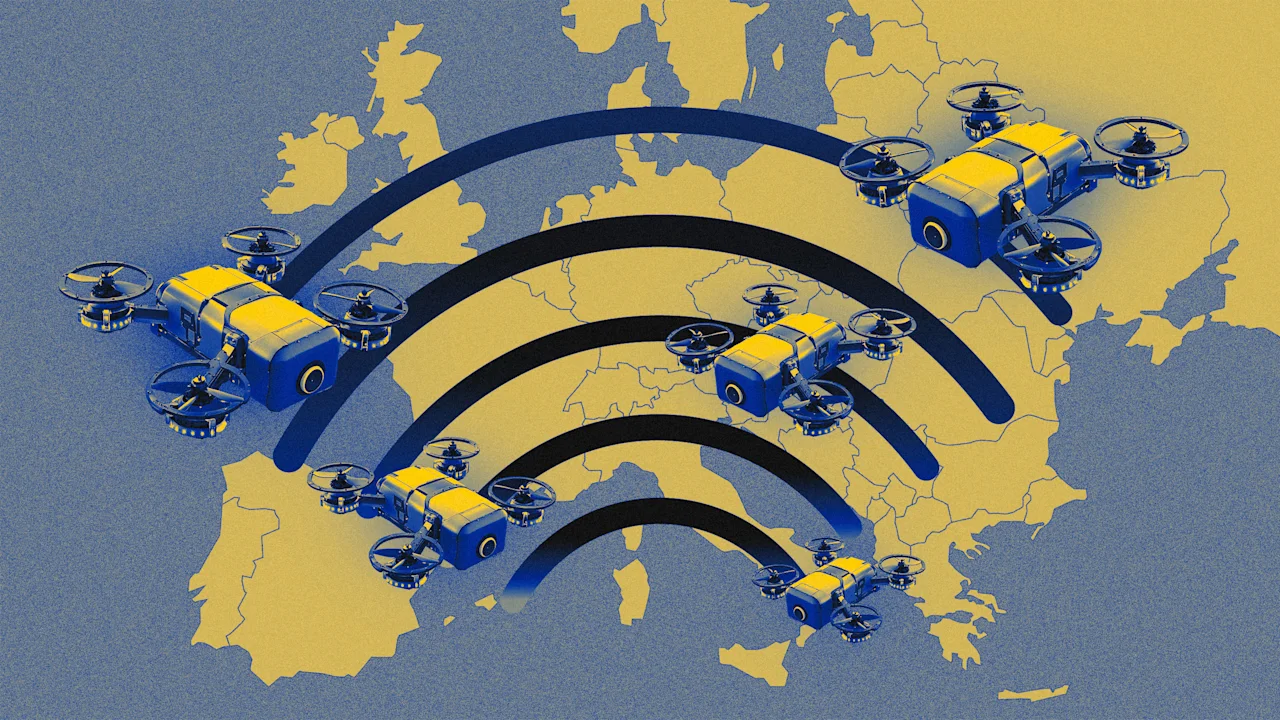
Two European innovation agencies—Germany’s SPRIND and Sweden’s Vinnova—are jointly funding cross-border teams to develop anti-drone systems capable of protecting airports, nuclear plants, and civilian sites from hostile unmanned aircraft. The partnership, formalized last year, marks a rare collaboration between public innovation bodies and comes amid escalating drone threats in conflict zones and repeated sightings over European airports in late 2025.
“We need to have a fundamentally different way of funding innovation if we want to see different results,” says Jano Costard, head of challenges at SPRIND. “If we as SPRIND would have just copied what everybody else did, then what would be our added value?”
One team backed by the agencies is led by Martin Saska, a robotics professor at Czech Technical University in Prague, who is developing anti-drone technology. The initiative goes beyond supporting a single company; it aims to give Europe a way to stand firm amid shifting global alliances.
Background
Both SPRIND and Vinnova are modeled on DARPA, the U.S. defense agency credited with creating the internet and GPS, but with the military framing stripped away. SPRIND, founded in 2019, gained unusual legal latitude through a 2023 German parliamentary act that allows it to take equity stakes in startups—a power most German public bodies lack.
Vinnova, more than 20 years older, has operated with a similar playbook. Sweden, with a population of just 10 million, produced more than 500 IPOs in the past decade—more than Germany, France, Spain, and the Netherlands combined. The partnership is a deliberate response to the Draghi report, which warned that Europe was falling behind in bringing radical ideas to market at speed and scale.
What This Means
The choice of drones for the agencies’ first joint initiative is no accident. Beyond their integral role in Middle Eastern conflicts, repeated drone sightings over European airports have rattled governments. There is also growing anxiety about Russian- and Chinese-made hardware in critical infrastructure, making anti-drone technology a top priority for European police forces and militaries.
However, Europe’s drone sector remains highly fragmented. Costard argues that without coordinated demand across member states, no startup can build a viable business. “If every police force that would like to buy drone interceptors posts different requirements, that’s a nightmare for any small startup,” he warns.
Darja Isaksson, director general of Vinnova, emphasizes the need for scaling: “Europe as a whole needs to invest more in radical breakthrough innovation, and we also need to figure out ways of really supporting the journey to scale. The aim is to make it easy for private sector VC to spot that and to crowd in.”
The SPRIND-Vinnova partnership offers a new model for European defense innovation—one that bypasses traditional procurement and fosters rapid, cross-border development of technologies that can counter immediate aerial threats.