Breaking: TurboQuant Redefines LLM Compression
Google today announced the release of TurboQuant, a new algorithmic suite and library designed to dramatically reduce the memory footprint of key-value (KV) caches in large language models (LLMs).
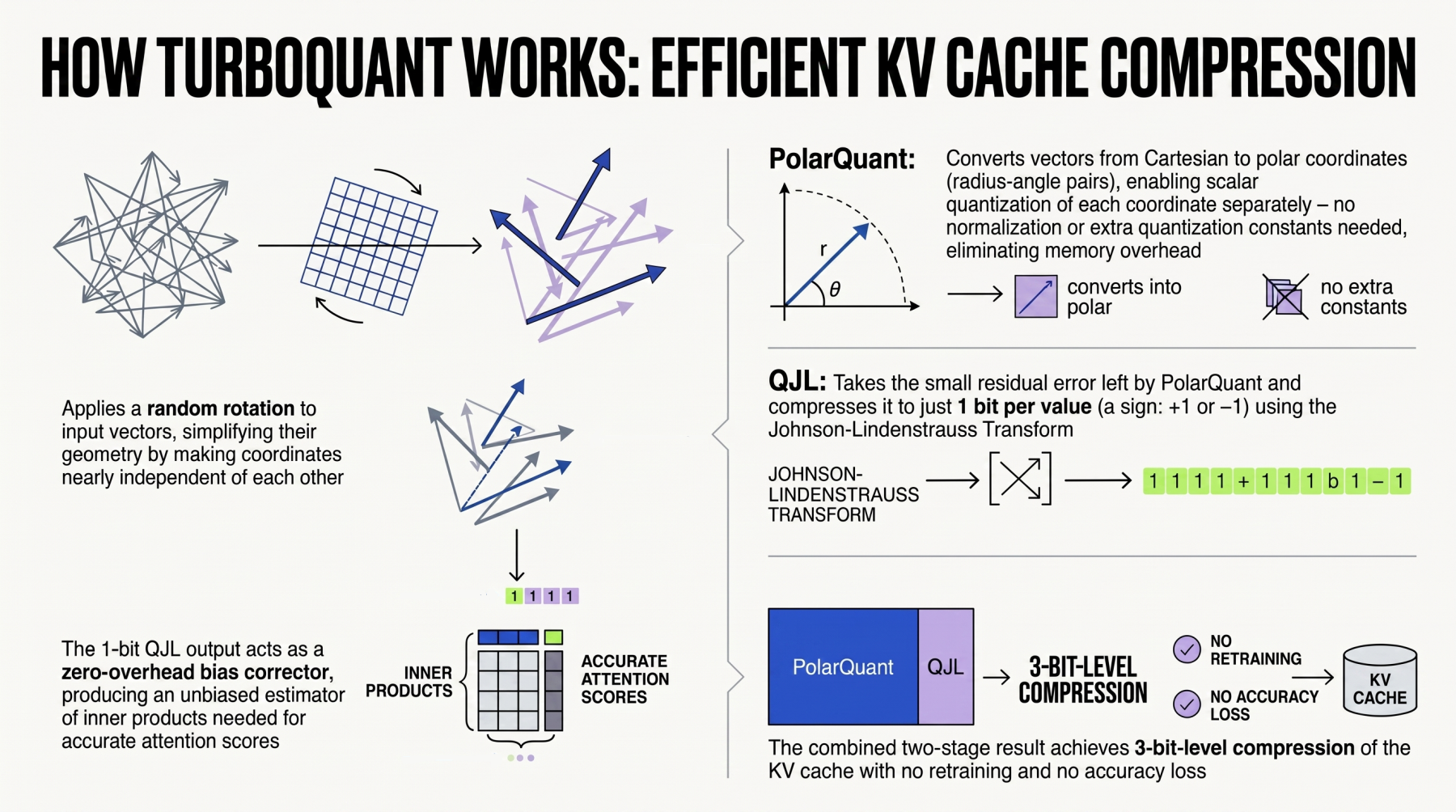
The tool also targets vector search engines, which are critical components of retrieval-augmented generation (RAG) systems. Early benchmarks suggest TurboQuant can cut KV cache size by up to 4x with minimal accuracy loss.
Expert Insights on the Announcement
“TurboQuant tackles one of the most pressing bottlenecks in production AI: the explosion of KV cache memory during long context inference,” said Dr. Aisha Patel, a senior research scientist at Google AI. “Our quantization methods preserve model fidelity while enabling deployment on existing hardware.”
Industry analyst Mark Chen of Gartner noted, “This could be a game changer for enterprises running LLMs at scale. Memory costs have been a hidden tax on generative AI adoption.”
Background: Why KV Compression Matters
In transformer-based LLMs, the KV cache stores intermediate attention states to avoid recomputing them for each new token. As context windows grow to 128K tokens or more, this cache can consume gigabytes of high-bandwidth memory (HBM) per request.
Traditional quantization methods have struggled to balance compression with retention of long-range dependencies. TurboQuant uses an adaptive quantization scheme that allocates more bits to cache entries critical for attention accuracy, while aggressively compressing less important ones.
The library integrates with popular frameworks like TensorFlow, PyTorch, and JAX. Google has open-sourced the core algorithms under an Apache 2.0 license.
What This Means for AI Infrastructure
Cost reduction: Smaller KV caches mean more concurrent requests can be served on the same GPU cluster. Early tests show up to 60% lower inference cost per query.
Longer contexts: By compressing cache by 4x, models can process documents of 1 million tokens without exceeding memory budgets. This unlocks new use cases in legal, medical, and code analysis.
RAG optimization: Vector search engines often cache embeddings for fast retrieval. TurboQuant’s compression of vector indices reduces storage overhead while maintaining recall above 99% in benchmark datasets.
Dr. Patel emphasized, “We are seeing production systems that previously required 8×A100 GPUs now running efficiently on a single H100.”
Immediate Availability and Next Steps
TurboQuant is now available as a pip install turboquant package. Google plans to release pre-compressed model adapters for its Gemma and Gemini families later this quarter.
The research paper, “Efficient KV Cache Compression via Adaptive Post-Training Quantization,” is included in the repository and has been accepted at the upcoming NeurIPS 2025 conference.
For developers eager to reduce memory bottlenecks, the library includes quickstart notebooks and benchmarking scripts.
The Bottom Line
TurboQuant addresses a critical infrastructure challenge as AI moves toward larger models and longer contexts. By compressing KV caches without sacrificing quality, it lowers barriers to entry for cost-sensitive deployments.
“This isn’t just about saving memory,” said Dr. Patel. “It’s about making advanced AI accessible to everyone, from startups to global enterprises.”