Introduction to a New Era of Agentic AI
The landscape of artificial intelligence is shifting rapidly, with agentic AI—systems that can autonomously perform tasks—taking center stage. Following the momentum of frameworks like OpenClaw, the open-source community has embraced a new contender: Hermes Agent. Developed by Nous Research, this framework has skyrocketed to over 140,000 stars on GitHub in less than three months and, according to OpenRouter, recently became the most widely used agent globally. Its appeal lies in two critical features: reliability and the ability to self-improve, both historically challenging for AI agents.
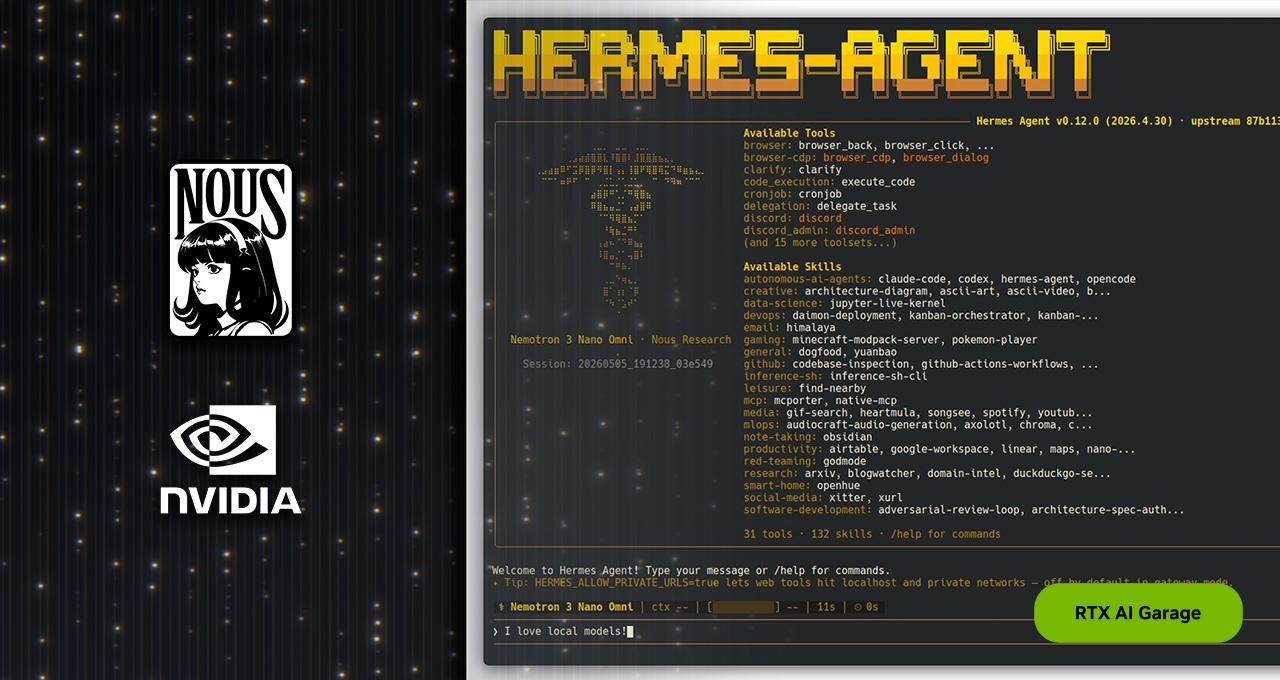
Hermes is designed to be provider- and model-agnostic, and it is optimized for continuous local operation. This makes it an ideal match for hardware like NVIDIA RTX PCs, NVIDIA RTX PRO workstations, and NVIDIA DGX Spark, which deliver the sustained performance needed for round-the-clock agentic workloads.
Hermes: A Locally Accelerated Agent with Unique Capabilities
Like other popular agents, Hermes integrates with messaging apps, accesses local files and applications, and runs 24/7. However, four standout features set it apart from the competition.
Self-Evolving Skills
Hermes doesn’t just execute predefined tasks—it learns from every interaction. When faced with a complex challenge or user feedback, it saves the experience as a new skill. Over time, this allows the agent to adapt and improve automatically, reducing the need for manual intervention.
Contained Sub-Agents
To keep tasks organized and efficient, Hermes spawns short-lived, isolated sub-agents for specific subtasks. Each sub-agent operates with a focused context and limited toolset, minimizing confusion and allowing the main agent to run with smaller context windows. This design is particularly beneficial for local models with limited memory.
Reliability by Design
Nous Research curates and stress-tests every skill, tool, and plug-in included with Hermes. The result is a framework that works reliably—even with 30-billion-parameter-class local models—without the constant debugging that plagues many other agent frameworks.
Better Results from the Same Model
Developer comparisons consistently show that Hermes outperforms other frameworks when using identical underlying models. This is because Hermes acts as an active orchestration layer rather than a thin wrapper, enabling persistent, on-device agents instead of task-by-task execution. The hardware quality directly influences user experience, and NVIDIA RTX GPUs are purpose-built for such workloads.

Qwen 3.6: Data Center-Level Intelligence on Local Hardware
The Qwen 3.6 series from Alibaba represents a major leap for local AI agents. These open-weight large language models (LLMs) are designed to run efficiently on consumer-grade hardware while delivering performance that rivals much larger models from previous generations.
Unprecedented Efficiency
The Qwen 3.6 35B model, for example, requires only about 20GB of memory yet surpasses the previous 120-billion-parameter model, which needed over 70GB. Similarly, the new Qwen 3.6 27B dense model matches the accuracy of the earlier 400-billion-parameter model, despite having far fewer active parameters. Both models are ideal for running local agents like Hermes on NVIDIA RTX and DGX Spark hardware.
These advancements mean that users can now run sophisticated AI agents entirely on their local machines, without relying on cloud services. The combination of Hermes’ adaptive framework and Qwen 3.6’s efficient architecture unlocks new possibilities for privacy, latency, and cost savings.
Conclusion: The Future of Local Agentic AI
With Hermes Agent and Qwen 3.6, the dream of fully autonomous, self-improving AI assistants operating on personal devices is becoming a reality. By leveraging NVIDIA’s powerful RTX and DGX platforms, users can experience data center-level intelligence at home or in the office. As the open-source community continues to refine these tools, the line between local and cloud AI will only blur further.