Introduction
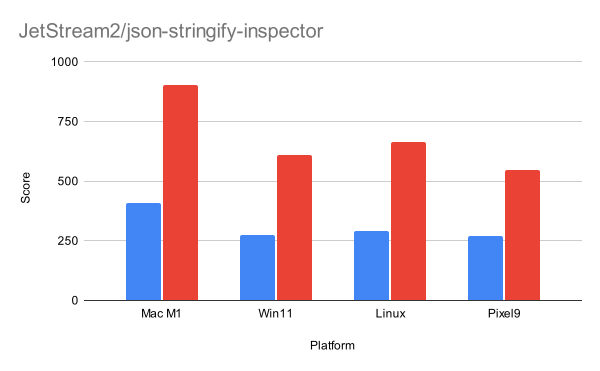
JSON.stringify is everywhere in JavaScript—serializing data for API calls, saving to localStorage, or preparing objects for transmission. But let's face it: performance matters. A slow stringifier means sluggish interactions and frustrated users. That's why we're thrilled to reveal that V8's latest engineering push has slashed JSON.stringify's execution time by more than half. In this listicle, we dive into the six key optimizations behind this double-speed leap. From eliminating side effects to rethinking string handling, each tweak adds up to a dramatically faster, more reliable serialization pipeline. Ready to peek under the hood? Let's go.
1. A Side-Effect-Free Fast Path
The cornerstone of the speedup is a new fast path that activates only when V8 can guarantee the serialization will cause zero side effects. A side effect here is anything that breaks the straightforward top-down traversal of an object—not just user-defined toJSON functions, but also internal triggers like garbage collection. By proving the operation is pure, V8 bypasses the general-purpose serializer's expensive checks and defensive code. For most plain-data objects (the kind you'll find in JSON.parse(JSON.stringify(obj)) patterns), this fast path applies automatically, delivering a noticeable boost without any change to your code.
2. Iterative Over Recursive
The old serializer was recursive—neat for coding, but costly. Each recursive call required a stack overflow check and couldn't easily resume after encoding changes. The new implementation is iterative, using an explicit stack. This architectural shift removes the overhead of recursive function calls, eliminates stack-overflow checks, and allows the serializer to pause and resume efficiently. As a bonus, iterative traversal handles arbitrarily deep object graphs—objects nested hundreds of levels deep—without hitting the call stack limit. It's a win for both speed and stability.
3. Templatized String Handling
Strings in V8 come in two flavors: one-byte (ASCII) and two-byte (Unicode). A unified serializer must constantly branch to handle both, blunting performance. The solution? Template the entire stringifier on the character type. V8 now compiles two specialized serializers: one fully optimized for one-byte strings, another for two-byte. This doubles the binary size, but the performance uplift—especially on ASCII-heavy workloads—is dramatic. Branching is replaced by static dispatch, and each path uses lean, type-specific routines.
4. Efficient Mixed Encoding Handling
Real-world data often mixes ASCII and Unicode characters. Even on the fast path, V8 must inspect every string's internal representation to detect types that require a slow-path fallback (for example, ConsString, whose flattening could trigger a GC). The optimized serializer performs this inspection only once per string, and thanks to the templatized design, the check is tightly integrated. Mixed encoding no longer forces a full switch to the slow serializer—only specific problematic representations are diverted, keeping most of the workload on the fast path.
5. Bypassing Expensive Checks
The general-purpose serializer is a security blanket: it checks for proxy traps, getters, prototype mutations, and more. These checks are essential when side effects are possible, but they're pure overhead for plain objects. The side-effect-free fast path skips them entirely. For instance, V8 no longer verifies that property accessors haven't been tampered with, because the fast path guarantees no side effects. This alone shaves off significant microseconds per call, especially on objects with many properties.
6. Binary Size vs. Performance Trade-off
Compiling two specialized serializers (one per string type) increases V8's binary size—a trade-off the team accepted after measuring the gains. This optimization wouldn't make sense for rarely used features, but JSON.stringify is called billions of times daily. The extra kilobytes in the engine are repaid thousands of times over in reduced user-perceived latency. It's a classic case of spend memory to save time, and for a core function, the equation clearly favors speed.
Conclusion
V8's double-speed boost for JSON.stringify didn't come from a single magic bullet. It's the result of meticulous engineering: a side-effect-free fast path, iterative traversal, templatized string handling, and careful trade-offs between binary size and runtime performance. For developers, this means faster apps with zero code changes—just a browser update. Next time you JSON.stringify an object, know that behind the scenes, V8 is moving at lightning speed. Want to dive deeper into the technical details? Check out the original V8 blog post for the full story.