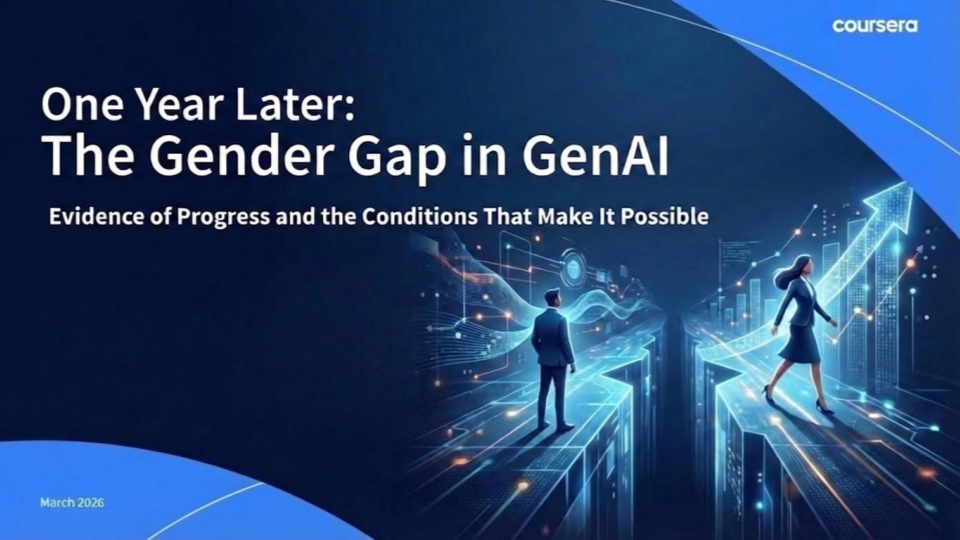
As International Women’s Day approaches, new research from Coursera sheds light on both advancements and ongoing disparities in women’s engagement with Generative AI (GenAI) learning. The report, titled One Year Later: The Gender Gap in GenAI, reveals encouraging global trends—such as a rise in women’s GenAI enrollments from 32% to 36% overall—alongside concerning setbacks in some developed nations. With GenAI projected to add up to $22.3 trillion to the global economy by 2030 (IDC), ensuring equal access to these skills is more critical than ever. Below, we explore the key findings and what they mean for the future of work and gender equity.
What does the new Coursera report reveal about the gender gap in GenAI skills?
The report, released ahead of International Women’s Day, updates Coursera’s original analysis from one year ago. It finds that although women remain underrepresented in GenAI learning globally, the gap is steadily narrowing. Women’s share of total GenAI enrollments on Coursera rose from 32% in 2024 to 36% in 2025—a clear sign of progress. Among enterprise learners, the improvement is even more striking: women accounted for 36% of GenAI enrollments in 2024 and 42% in 2025. This indicates that women in professional settings are rapidly increasing their engagement with the technology, outpacing their male peers in growth rate. The report also highlights significant regional variations, with some areas making much faster strides than others. These insights are critical for policymakers and educators aiming to close the gender gap in high-demand digital skills.
Why is closing the gender gap in GenAI important for the global economy?
Generative AI is poised to reshape industries and drive unprecedented economic growth. According to IDC research, GenAI could increase global wealth by as much as $22.3 trillion by 2030. However, these gains will only be distributed fairly if all individuals—regardless of gender—have the skills to harness the technology. If women continue to be underrepresented in GenAI learning, they risk being left behind in a rapidly evolving job market. This could exacerbate existing economic inequalities and stifle innovation by excluding diverse perspectives. By ensuring women have equal access to GenAI training, institutions can help create a more inclusive and prosperous future. Closing the gender gap isn’t just a matter of equity—it’s an economic imperative that benefits entire societies.
How has women's participation in GenAI learning changed globally?
Over the past year, women’s participation in GenAI learning on Coursera has increased noticeably. Globally, their share of all GenAI enrollments rose from 32% in 2024 to 36% in 2025. In the enterprise sector, the growth was even more pronounced, climbing from 36% to 42% over the same period. This indicates that women are not only joining GenAI courses in greater numbers but also outpacing the overall growth rate—meaning their engagement is accelerating faster than men’s. However, the global average masks stark regional differences. While Latin America and parts of Asia Pacific have seen significant gains, many English-speaking developed countries have experienced a decline in women’s relative share of enrollments. These mixed results highlight the need for targeted interventions to maintain momentum across all regions.
Which regions are leading in narrowing the gender gap in GenAI?
The report identifies Latin America and Asia Pacific as standout regions. In Latin America, female GenAI enrollments on Coursera doubled year-over-year. Top performers include Peru with a 14.5 percentage point increase in women’s share, Mexico with 5.3 points, and Colombia with 4.5 points. In Asia Pacific, Uzbekistan leads globally with an 8.8 percentage point rise. India, Coursera’s largest GenAI market, saw a 2.2 percentage point increase, while Vietnam, Indonesia, Thailand, and the Philippines also posted gains. These countries demonstrate that focused educational initiatives and cultural shifts can accelerate women’s participation in cutting-edge technology fields. The progress in these regions offers valuable lessons for others seeking to close the gender gap.
Why are some English-speaking developed countries falling behind?
Despite global progress, several English-speaking and economically developed nations have seen women’s share of GenAI enrollments decline. In the United States, women’s share dropped 0.9 percentage points; Canada decreased by 1.0 point; the United Kingdom by 1.8 points; Spain by 1.1 points; and Germany by 0.2 points. This counterintuitive trend may reflect a rapidly growing interest in GenAI among men in these countries, outpacing even the absolute growth in women’s enrollments. Cultural factors, such as persistent stereotypes about tech and AI, could also play a role. Additionally, the availability of alternative training pathways for men may widen the gap. These findings underscore the need for targeted outreach and support to ensure women in developed economies are not left behind in the GenAI revolution.
What can institutions do to accelerate women's engagement with GenAI?
To build on the progress seen in Latin America and Asia Pacific, institutions worldwide should adopt multifaceted strategies. First, they can create targeted scholarship programs and mentorship initiatives to encourage women to enroll in GenAI courses. Second, offering flexible, self-paced learning options can help accommodate diverse schedules and reduce barriers. Third, partnering with employers to integrate GenAI training into professional development programs—as seen in the enterprise sector’s success—can boost participation. Fourth, showcasing female role models and success stories in AI can counter stereotypes. Finally, governments and educational organizations should invest in early exposure to AI skills in schools, especially for girls. By combining these approaches, institutions can help ensure that women everywhere have the opportunity to thrive in the AI-driven economy.